Research interests
For my doctoral thesis I have studied in vivo the effect of oxysterols on reactive and tumoral astrocytes.
Following a neuronal death due to a trauma, a neurodegenerative disease or a neurotoxic insult, astroglial cells undergo hypertrophy and hyperplasy. Astrocytes change their morphology and extent numerous fibres that are rich in Glial Fibrillary Astrocytic Protein (GFAP), the main astroglial intermediate filament. A subpopulation of astrocytes undergoes mitotic proliferation. The morphologically transformed astrocytes are termed reactive astrocytes and form a glial scar that may hinder axonal regrowth in the CNS. During my PhD I have studied the effect of oxysterols on astrocytic activation and proliferation in vivo and in vitro.
Oxysterols are cholesterol derivatives with an additional oxygenated function, e.g. hydroxyl or ketone function. The 7ß-hydroxycholesterol (7ß-CHOH) is cytotoxic to cultured tumoral astrocytes without affecting primary cultured astrocytes or neurons. The cytotoxicity is linked to the synthesis by the cells of derivatives with the hydroxy function on C-3 esterified by a fatty acid (Behr et al.; 1991, FEBS Letters 280: 202-206). I have demonstrated that 7ß-CHOH and 7ß-CHOH-3-esters reduce the extend of an astrogliosis induced by an electrolytic lesion in the frontal cortex of 6-day-old or adult rats (Bochelen et al.; 1992, Neuroscience 51 : 827-834). The most active molecule, 7ß-CHOH-3-oleyl inhibited the morphologic transformation and the proliferation of astrocytes. Structure-activity studies showed that the molecules that had the greater efficacy in reducing astrogliosis and astrocyte proliferation, also were the most potent inhibitors of the cholesterol biosynthesis pathway (Bochelen et al.; 1995, J. Neurochem. 65: 2194-2200).
Local injection of 7ß-CHOH-3-oleyl after an hemisection of the spinal cord of rats favored the growth of serotonergic fibers from the intact side into the lesioned side (Gimenez y Ribotta M. et al.; 1995, J. Neurosci. Res. 41: 79-95).
During my postodoctoral period in the laboratory of Dr. Mersel at the Centre de Neurochimie I attempted to establish an in vitro model of reactive astrocytes.
To better understand the molecular mechanisms underlying the effect of oxysterols I established an in vitro model of reactive astrocytes. Treatment of primary cultures of cortical astrocytes with dibutyryl-cAMP or a b-adrenergic receptor agonist, resulted in an increased level of intracellular cAMP and in a morphological transformation analogue to that observed in vivo. The 7ß-CHOH was cytotoxic toward these morphologically transformed astrocytes whereas it did not affect normal astrocytes. Inhibition of the cAMP increase by a b-adrenergic receptor antagonist abolished the cytotoxicity of 7ß-CHOH (Bochelen et al.; 1995 Congrès International de l'Institut de Recherche sur la Moelle Epiniere, Deauville, France). Assay of the activity of the cAMP-dependent kinase (PKA) showed that a transient, short-term inhibition of the PKA activity occured in astrocytes treated with both db-cAMP and 7ß-CHOH that may inturn affect the expression of various genes (GFAP, NCAM…) that are regulated by the transcription factor CREB.
My time as a postdoctoral scientist in the Neurodegeneration unit of the preclinical research of Novartis Pharma was dedicated to study of cerebral ischemia. I have used an experimental model of focal cerebral ischemia in rodents. This model consists in a transient occlusion of the Middle Cerebral Artery (MCA) of rats and mice with a nylon suture that was introduced into the extracranial part of the Internal Carotid Artery. This method preserves the integrity of the skull and allows precisely controlled reperfusion of the artery.
I first have characterised the model in spontaneously hypertensive rats. Cerebral Blood Flow (CBF) dynamic was measured either by a non-invasive MRI method or radioactive tracer method (Allegrini P., et al. Quantitative measurement of regional cerebral blood flow: Correlation of MRI perfusion measurements using arterial spin tagging or bolus tracking with the 14C-iodoantipyrine method; 6th meeting of the International Society for Magnetic Resonance in Medecine, April 1998, Sydney). The outcome of MCAOs of various durations was assessed at early time-points (24-48h) by T2-weighted MRI, correlated with vital tissue staining and histolgical staining at latter time-points (1-3 weeks).
I used the transient MCAO model to test the neuroprotective properties of the immunosuppresive drugs, FK506, ASM-981 and rapamycin. The read-outs were MRI, vital staining and histology. We have shown that a relation between the neuroprotection properties and the inhibition of the phosphatase calcineurin (Bochelen et al., 1999, J. Pharmacol. Exp. Therap. 288 : 653-659).
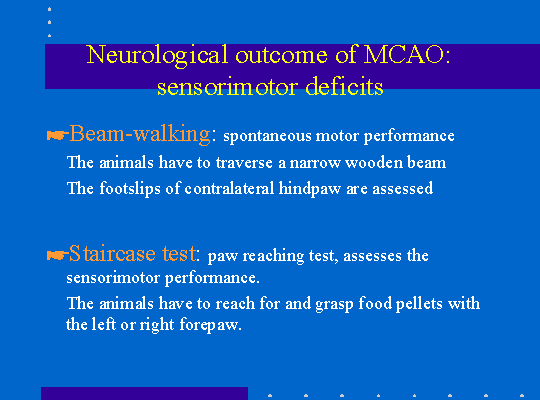
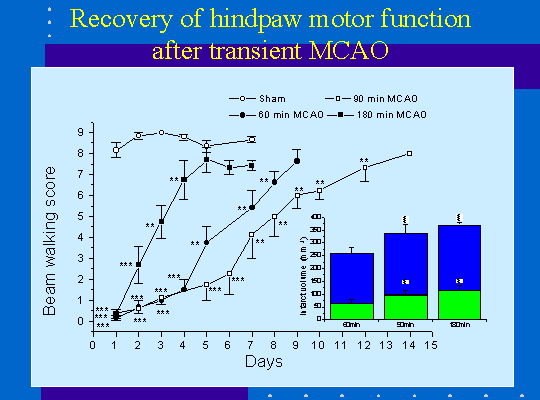
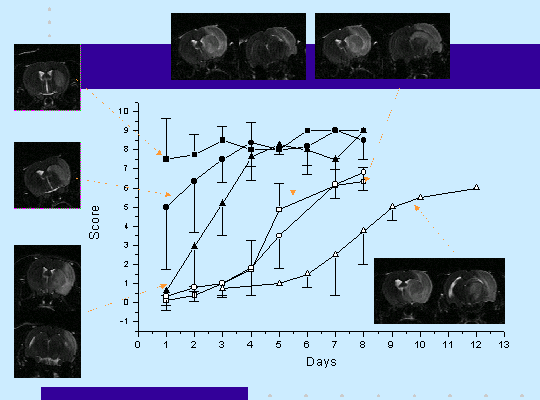
The neurological consequences, i.e. sensorimotor deficits, of a focal brain ischemia of increasing severity were studied using the beam-walking and staircase tests (figure1). Transient MCAO in rats resulted in severe sensorimotor deficits on the hindpaw contralateral to the lesioned hemisphere, as assessed with the beam-walking test, which recovered within days (figure 2). The speed of the functional recovery depended on the MCAO duration and consequently on the lesion size (figure 2), peculiarly in the somatosensory cortex (figure 3). Lesion of the hippocampus did not affect the recovery of motor function whereas infarction of the thalamus resulted in a very delayed and incomplete recovery of sensorimotor deficits (figure 3).
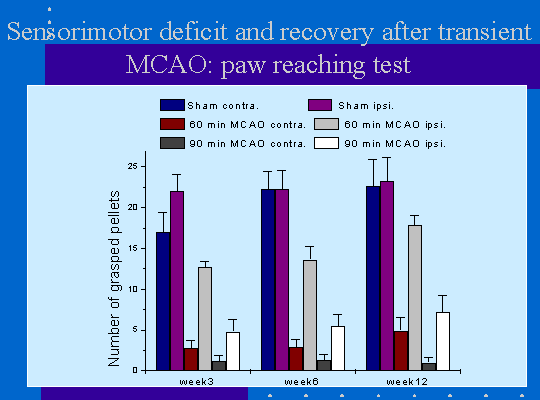
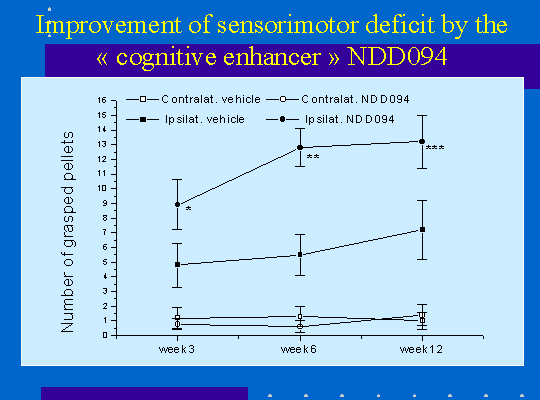
Focal cerebral ischemia resulted also in a deficit of the reaching and grasping ability, as assessed with the staircase test, on both forepaws (figure 4). The sensorimotor impairment of the paw contralateral to the lesion remained severe over 15 weeks regardless of the MCAO duration. The ispsilateral paw improved over time in the group that had the less severe lesion (60-min MCAO). Treatment with NDD094 a " cognitive enhancer " resulted in an improvement of the grasping performance of the ipsilateral paw (figure 5).